

If you’ve ever heard someone say, “Running is bad for your knees,” you may have wondered whether all those miles are slowly wearing away your joints.
Maybe you’ve even stopped running because you’re worried about developing arthritis.
But here’s the good news:
Running does not automatically cause knee osteoarthritis.
In fact, research comparing runners with non-runners has found that recreational runners may actually have lower rates of hip and knee osteoarthritis than people who don’t run.
So where did the idea that running “ruins your knees” come from?
Let’s take a closer look at what the research tells us—and what it means if you’re a runner, thinking about becoming a runner, or currently avoiding running because of knee pain.
The Myth: Running Wears Out Your Knees
The logic seems straightforward:
Running → impact → wear and tear → arthritis.
But our bodies aren’t machines with a finite number of miles.
Our bones, muscles, tendons, cartilage, and other tissues are living structures that respond to the demands we place on them.
Load isn’t inherently bad.
In fact, appropriate loading is an important part of keeping the musculoskeletal system strong and capable.
The better question isn’t:
“Is running bad for my knees?”
It’s:
“Is my body prepared to handle the amount of running I’m asking it to do?”
That distinction is incredibly important.
What Does the Research Say About Running and Osteoarthritis?
One of the largest reviews examining this question looked at more than 100,000 people and compared osteoarthritis rates among recreational runners, competitive runners, and non-runners.
The results were interesting.
Researchers found:
- 3.5% of recreational runners had hip or knee osteoarthritis
- 10.2% of non-runners had hip or knee osteoarthritis
- 13.3% of very high-volume competitive runners had hip or knee osteoarthritis
So recreational runners had a substantially lower prevalence of hip and knee osteoarthritis than non-runners.
Does this mean running prevents arthritis?
Not necessarily.
This type of research shows an association rather than proving that running itself prevents osteoarthritis. There are many other factors that can influence joint health.
But it does challenge the idea that recreational running automatically “wears out” your knees.
And that’s an important distinction.

Your Knees Are Designed to Handle Load
Every time you walk, climb stairs, squat, hike, lift something, or run, your body experiences load.
Your joints are designed for this.
The goal isn’t to eliminate stress from your body.
The goal is to gradually build your capacity to handle it.
Think about strength training.
You don’t walk into a gym for the first time and immediately deadlift 300 pounds.
You start with an appropriate amount of resistance, allow your body to adapt, and gradually increase the challenge.
Running should be approached in a similar way.
If your current capacity is 10 minutes of comfortable running, jumping immediately to 5 miles isn’t necessarily a great idea.
But that doesn’t mean running is bad for your knees.
It may simply mean you need to build your capacity gradually.
What If You Already Have Knee Arthritis?
Having osteoarthritis doesn’t automatically mean you need to avoid impact forever.
Research in people who already have hip or knee osteoarthritis has also challenged the idea that higher-impact activity is necessarily harmful to the joints.
A 2026 study of more than 17,000 people with hip or knee osteoarthritis found that participation in higher-impact physical activity was associated with lower odds of hip replacement over the following year. The study did not find the same association with knee replacement.
Importantly, this was an observational study, so it cannot prove that high-impact exercise prevents joint replacement.
But it does reinforce an important concept:
Osteoarthritis does not automatically mean “stop moving.”
Your exercise program should consider your symptoms, your current strength and capacity, your goals, and how your body responds to increasing load.
What About Running With Knee Pain?
This is where things get a little more individualized.
Pain doesn’t automatically mean damage.
But persistent pain is also something you shouldn’t simply ignore and hope it disappears.
If your knee starts bothering you when you run, the answer isn’t necessarily to give up running forever.
Instead, we want to understand:
- When does the pain occur?
- How much running can you currently tolerate?
- Did your mileage increase recently?
- Have you changed your pace, terrain, or training schedule?
- Are you recovering adequately?
- Is there a strength or mobility limitation contributing to the problem?
- How does your knee respond after running and the following day?
Sometimes the solution is simply modifying your training load.
Sometimes you need to build strength.
Sometimes you need to temporarily change how much impact you’re doing.
And sometimes there is an underlying issue that deserves a more thorough evaluation.
That’s where physical therapy can be incredibly helpful.
Are You Running Your First Race?
If you’re training for your first 5K, 10K, half marathon, or other race, don’t wait until something hurts to start thinking about your body’s capacity.
Your running program is only one piece of the puzzle.
You also need to prepare the body doing the running.
That may include:
Strength
Your calves, quads, hamstrings, glutes, and trunk all contribute to your ability to tolerate the repetitive demands of running.
Gradual Progression
Your body needs time to adapt to increasing mileage, speed, hills, and impact.
More isn’t always better.
The goal is to give your body enough stimulus to adapt without continually exceeding its recovery capacity.
Recovery
Running creates stress on your body.
Sleep, nutrition, rest days, and appropriate training progression all contribute to your ability to recover and adapt.
Don’t Ignore Small Problems
One of the biggest mistakes I see is waiting until a small problem becomes a big one.
A little discomfort after a run doesn’t necessarily mean something is seriously wrong.
But if something continues to hurt, changes the way you run, or progressively gets worse, it’s worth figuring out what’s going on.
Have You Stopped Running Because Your Knee Hurts?
Maybe you’ve run for years.
Then your knee started hurting.
You took some time off.
It got a little better.
You tried running again.
The pain came back.
So now you’ve decided:
“I guess I’m just not a runner anymore.”
Before you give up on something you love, let’s figure out why your knee isn’t tolerating the activity right now.
Sometimes your body simply needs a different progression.
You may need to rebuild strength, improve your tolerance to impact, adjust your running volume, or address another factor contributing to your symptoms.
The goal isn’t necessarily to tell you to stop running.
The goal is to help you get back to doing what you love with confidence.
What If Running Hurts for More Than Two Weeks?
Here’s a simple rule I like to give runners:
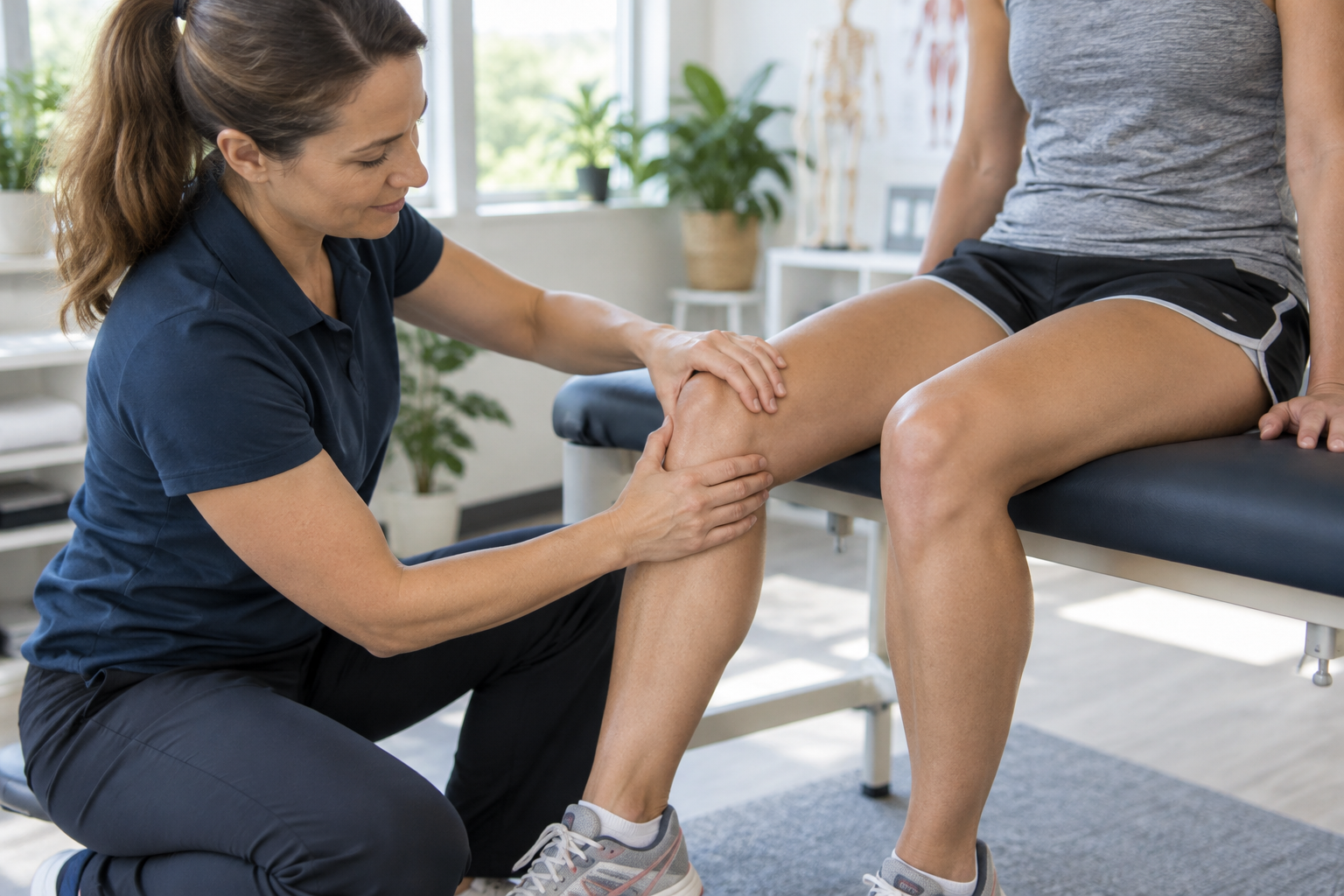
If something continues to hurt for more than two weeks, don’t just keep pushing through it. Get it assessed.
That doesn’t mean you have a serious injury.
It means you have enough information to know that something isn’t resolving on its own.
An evaluation can help determine whether you need to modify your training, strengthen a particular area, address mobility, change your running progression, or take a temporary break from certain activities.
The sooner you understand what’s contributing to the problem, the sooner you can make an informed plan to move forward.
Running Isn't the Enemy. Lack of Capacity Can Be the Problem.
This is one of the biggest shifts I want runners to make.
Instead of thinking:
“Running is bad for my knees.”
Think:
“How can I make my body more capable of running?”
That might mean strength training.
It might mean gradually increasing mileage.
It might mean improving recovery.
It might mean addressing an existing injury.
And sometimes it simply means getting an individualized assessment so you understand what your body needs.
At Soma Vita Physio & Wellness, we take a whole-body approach to helping active adults stay active.
Our goal isn’t to take away the activities you love.
It’s to help you build the strength and capacity to keep doing them.
Ready to Get Back to Running?
Whether you’re preparing for your first race, getting back to running after time away, or you’ve been avoiding running because of persistent knee pain, you don’t have to figure it out alone.
If your knee has been bothering you for more than two weeks—or you’re simply unsure whether your body is ready for the demands of running—we can help you understand what’s going on and create a plan based on your body, your goals, and the activities you want to get back to.
Book a Discovery Call with Soma Vita Physio & Wellness
Let’s talk about what’s going on, what you’re trying to get back to, and whether working together is the right next step.
Your knees aren’t something you need to be afraid of.
Let’s build a body that’s ready for the life you want to live.
References
- Alentorn-Geli E, Samuelsson K, Musahl V, Green CL, Bhandari M, Karlsson J. The Association of Recreational and Competitive Running With Hip and Knee Osteoarthritis: A Systematic Review and Meta-analysis. Journal of Orthopaedic & Sports Physical Therapy. 2017;47(6):373–390. doi:10.2519/jospt.2017.7137.
- Bohm S, Mersmann F, Santuz A, Arampatzis A. Enthalpy efficiency of the soleus muscle contributes to improvements in running economy. Proceedings of the Royal Society B: Biological Sciences. 2021;288(1943):20202784. doi:10.1098/rspb.2020.2784.
- Liew BXW, Grønne DT, Roos EM, Skou ST. High-impact physical activity participation and 12-month risk of joint replacement: a longitudinal mediation analysis of 17,661 patients with knee or hip osteoarthritis. British Journal of Sports Medicine. 2026;60:1292–1297. doi:10.1136/bjsports-2026-111824.